Martin Theiller, “Kraken: a British Myth?”
The monstrous legend of the Kraken originated as a nautical tale shared by Norwegian fishermen in the late 17th and early 18th centuries. It eventually rose to prominence on the European stage after several Scandinavian works of natural history—all translated into English—introduced the sea monster to a wider and educated public in the late 18th century. This paper proposes to examine the crucial role Britain played in popularising the legend at the time and ensuring the survival of its legacy. Indeed, before the publication of highly popular novels by Jules Verne and H. P. Lovecraft, British travellers and poets had already appropriated this figure, which resonated with the political, aesthetic, and scientific concerns of the early 19th century. The Kraken appeared in the travelogues of English tourists and admirals, as well as in the ballads—and even the dreams—of some Romantic writers like Robert Southey, Walter Scott, and Alfred Tennyson. When the attention of the British public was drawn to Greenland, after the Admiralty launched new campaigns of exploration in search for the Northwest Passage, the Kraken also became a propaganda tool, a monster against which the worth of the explorers and the Empire could be tested in the Arctic seas. The analysis of these simultaneous cultural transfers will therefore suggest that, in spite of its Scandinavian origins, the Kraken developed into a British myth in the first half of the 19thcentury.
Michael Darroch, Toronto's TV Campus: Explorations in New Media Pedagogies
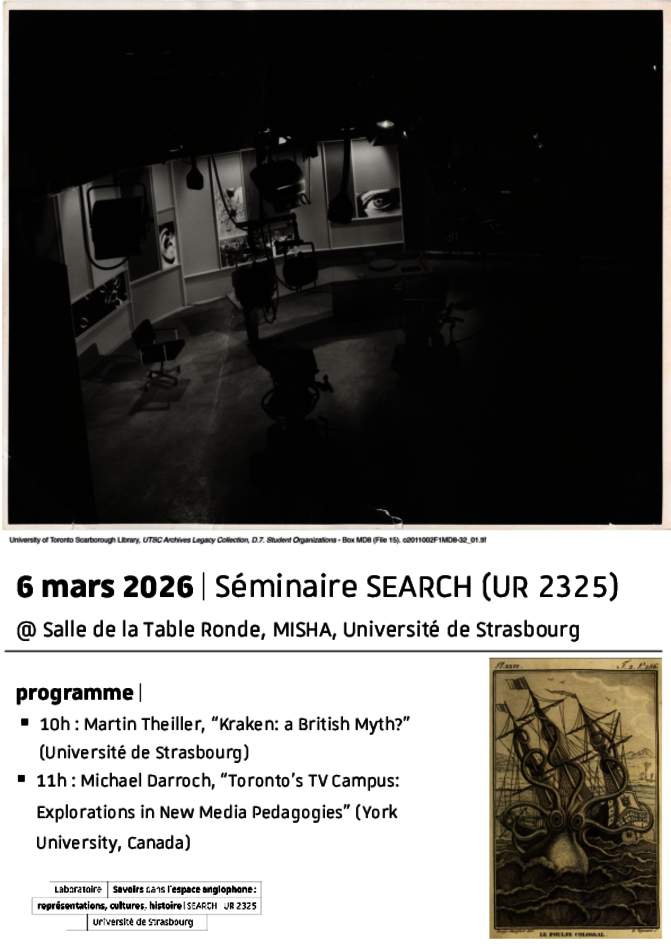
Building the technological university of the future has long been the goal of university campus expansions. This presentation considers the expansion project of the University of Toronto’s Scarborough College, promised in 1964 and delivered into the 1970s as an electrifying, experimental TV Campus. Scarborough generated a narrative of new architectural purpose enmeshed with technological infrastructure, and predictions of the future of learning based on the media of the day. Scarborough’s first Principal, D. Carlton Williams, was a member of Marshall McLuhan’s Explorations Group studying new media and changing patterns of behaviour in the 1950s. Williams saw an ambitious opportunity to pilot educational architecture that would interconnect classrooms and lecture halls via television. John Andrews Architects designed the central building which, through its emphasis on media and interconnection, was quickly likened with Expo 67’s architectural innovations. Andrews’ design connecting the Sciences and Humanities wings via hallways leading to a central atrium reflected the campus’s multidisciplinary purpose. While the campus garnered wide media acclaim, the TV experiment was largely abandoned by the 1970s as student appetite for TV learning waned and professors’ scepticism of televisual education rose. Nevertheless, the media campus of the future has persisted in the imaginations of university planners. The dream of interconnected sites of learning via television and future new media have driven expansions across Canadian provincial and US state systems. New campus projects today build on this legacy, promising high-tech programs connecting sciences, engineering, media, arts, and humanities. COVID-19 quickly ushered in new practices in online, hybrid, and hyflex learning that recalled language from Scarborough’s optimistic outlook until the 1970s. The early Zoom years resurrected questions posed during the Scarborough TV experiment, promising robust telepresence opportunities connecting campuses for the future of collaborative learning.