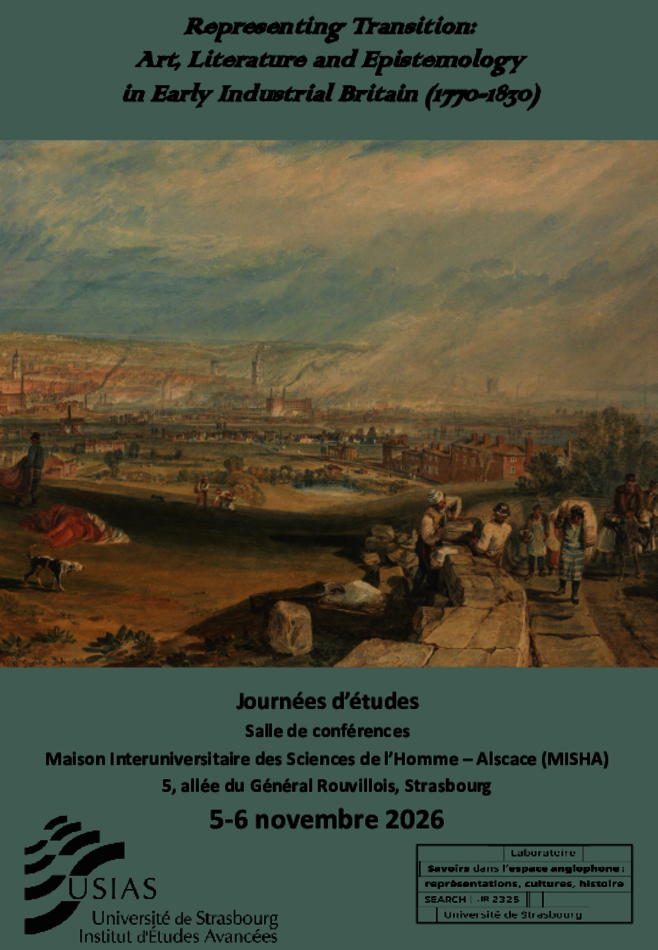
This symposium will bring together specialists of British Romanticism and of the First Industrial Revolution who share an interest in artistic and literary responses to early industrialization in the years 1780-1850. The interdisciplinary dialogue will explore the extent to which early industrialization reshaped the way human and natural environments were perceived and represented. Participants will include art historians, literary scholars, as well as specialists of economic, social, and science and technology history, in order to share methodologies and broaden discipline-specific perspectives. Among other things, the debate will aim to explore how ecocritical perspectives may be extended into art history, as well as focus on the variety of contexts and discourses that informed literary and artistic productions – such as technological innovations, extractive activities, or the development of modern scientific disciplines.
Colloque en ligne le 5 novembre (contacter hibata@unistra.fr), en salle de conférences de la MISHA le 6 novembre
PROGRAMME
Thursday, November 5
Workshop n°1: Dialectics of Art and Industry
Chair: Martin Theiller
9 :00 am – 10 :20 am
Peter Wakelin—Artists’ Views: motives and meanings in the Industrial Revolution
Jon Mee—“There are no limits to the power and resources of genius”: History, Industry, and the Romantic futurities
10:20 am – 10:40 am: Coffee Break
10: 40 am – 12:00 pm:
Muriel Adrien—Engineering the Landscape, Reframing the View: Barton Aqueduct and the Iron Bridge
Camille Adnot—Shore, Steam, and the Picturesque: Romantic Industrial Coastlines
Workshop n°2: Shades of Smog
Chair: Hélène Ibata
2:00 pm – 3:20 pm
Sarah Gould—“I would advise them also, to study landscape at some little distance from the smoke of London”: Air Pollution and the Picturesque in Britain and Its Empire
Elisabeth Ansel—Storm Clouds: Ecocritical Reflections on J.M.W. Turner’s Industrial Mist
3:20 pm – 3:40 pm: Coffee Break
3:40 pm – 5 pm
Frédéric Ogée—'if human hearts be dead, Speak, passing winds’: mist, steam and smoke in British landscape art 1780-1850
Ute Berns—Motorizing the Gaze: Writing Early Steamboat Mobility
Friday, November 6
Workshop n°3: Industryscapes on the Margins
Chair: Yann Tholoniat
9 :00 am – 10 :20 am
Mary-Ann Constantine—‘Llyn-y-Pandy, or, The Black Valley with the fire engine & great promontory become perfectly black from the smoke’ (1796)
Sophie Mesplède—James Ward’s 1807 Tweed Landscapes. The Angloseen and the Meaning of Border(s) Crossing
10:20 am – 10:40 am: Coffee break
10:40 am – 12:00 pm:
Adam Bridgen—Industry and Environment in the Art of Julius Caesar Ibbetson (1759-1817)
Hélène Ibata—“A working country is hardly ever a landscape”: Penry Williams’s South Wales Industrial Landscape (c. 1825)